
About Keila Church
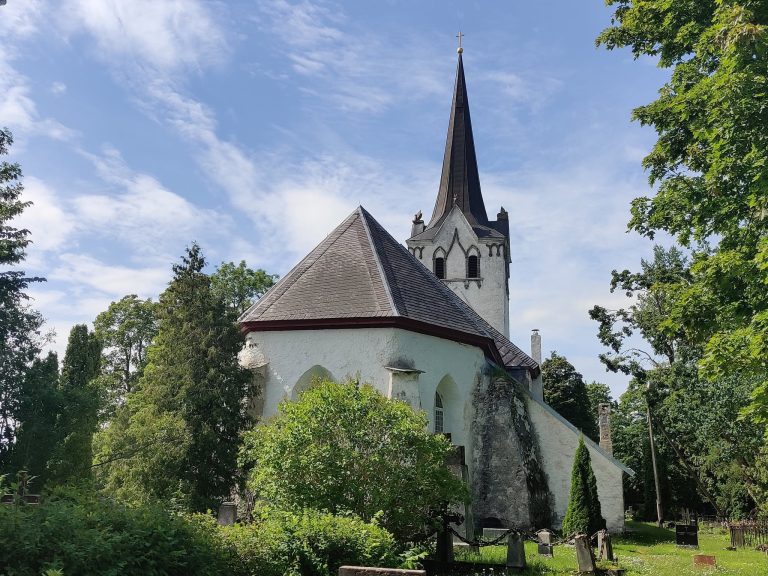
Keila Church is the largest medieval rural church in Harju County, and construction likely began soon after Northern Estonia’s subjugation to the Danish king. No records survive from the church’s earliest years, but around 1280 a spacious, four-sided chapel was completed on “Keila hill,” forming the choir of today’s church. The nave was not built at first, and was probably completed in the first half of the 14th century. Under the influence of the Dominican order, the nave was a simple, unvaulted, box-like structure. There were no windows in the north wall. The only doorway was in the west wall; the door’s carved stone frame follows the model of Tallinn’s Cathedral (Dome Church). Above the portal, the façade was marked by a square corbelled tower, parts of which survive within the present-day tower.
Until 1452, Keila Church was subordinate to Tallinn Cathedral, and afterward to the Toompea commandery. The change in jurisdiction brought major rebuilding in the late 15th and early 16th centuries. The work was led by stonemason Peter and master builder Merten of Tallinn. The massive west tower was built first. A three-sided apse was added to the choir, the choir was re-vaulted, and a stone altar table was built. The south portal was built in 1480. In 1489 the church was vaulted into a two-nave hall church — a fairly rare spatial layout among Estonian churches. References to the first organ in Keila Church also date from this period. A remarkably preserved account book from 1472–1553 records a payment in 1482 of 44½ marks to organ-builder Oly for work carried out. The account book also lists the church’s holdings, from which it appears Keila Church was very wealthy at the time. The church held four altars; the main altar bore a figure of the Virgin Mary with the infant Jesus, both dressed in velvet robes and wearing gold crowns. The church also had a small library of three liturgical books.

painting “Jacob’s Dream”
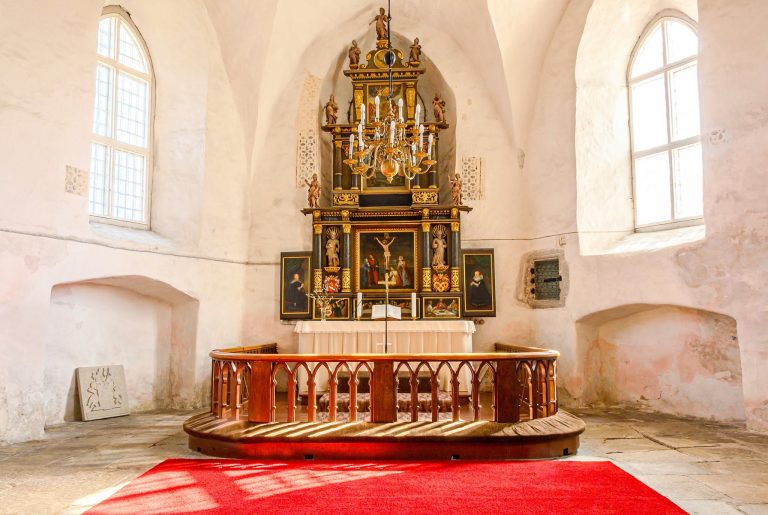
Keila Church suffered during the Livonian War in 1558, when the sanctuary’s furnishings were plundered. The church was restored by 1596. Today’s church furnishings date from after the Livonian War. Visitors are often drawn to the large Renaissance altarpiece, which comes from the Tallinn workshop of Tobias Heintze. The altarpiece was donated in 1632 by the Saku and Sausti estate owners Bernhard von Scharenberg and Anna von Rosen. The pulpit likewise comes from T. Heintze’s workshop and was completed in 1632; it was donated by the Klooga estate owners, the von Klugens. On the choir wall hangs the unique painting “Jacob’s Dream,” a memorial picture for pastor Morian, who died in the 17th century, which was used as a teaching aid in catechism classes. Provost Antonius Heidrich also wrote a study book to accompany the painting, though it was never printed. The church holds an interesting collection of chandeliers, the most striking of which hangs in front of the pulpit. It bears a German-language inscription: “Anno 1659. When Anthonius Heidrich of Tallinn was priest here, Kohna Iahn, who had accidentally killed Lambapeh Ivrri, had to give this chandelier to the church of Keila or Mihkli, for God’s honour and in memory of the slain.”
In 1839 a new organ was ordered from the Walcker workshop in Ludwigsburg, Germany, and installed in the church in 1843. It was the first organ with a Kegellade (cone-chest) system outside Germany. Around 1914, August Terkmann likely rebuilt the organ; it grew half again in size and was moved from its original place on the north gallery to its present spot on the west gallery. In 1997 a thorough restoration of the organ was undertaken, funded by donations from the town of Keila, local businesses, and private individuals.
The church took on its present outward form only in 1851, when a pseudo-Gothic rose window was built into the south wall (designed by J. G. Exner of Tallinn; the stained glass was restored in 1991), and the tower was decorated with arch motifs and the symbols of the evangelists (an angel for Matthew; a lion for Mark; an ox for Luke; an eagle for John). The main portal was framed with columns, above which winged cherubs and the symbol of the Holy Spirit — a dove descending from heaven — were placed. Inside the church, rebuilding work ended in 1939, when the still-functioning warm-air heating system was also installed. In the summer of 2004, major repair works on the church tower’s spire were completed, and a new cross was placed at its top.
In the churchyard, the 17th-century peasant ring-crosses draw attention. Four of them remain in their original location, and two have been moved to the church porch. The churchyard also contains several burial chapels. The most impressive of these is the chapel built for the Vääna estate’s von Stackelberg family, modelled on a Greek temple.
From 1906 to 1921, the pastor of Keila parish was Jakob Kukk, who in 1919 was elected the first ethnic Estonian bishop of Estonia.
Clergy who have served the parish
Not much information survives about the clergy who served Keila parish in the Middle Ages. In an article published in 1938 by Ado Köögardal, “Mõnda Keila kirikust” (“Something about Keila Church,” in the Christmas album of “Eesti Kirik”), we read: “In addition to deacons and a sexton, the church always had 2 clergy in office, namely a parish priest and his chaplain or vicar. The ‘Keila church wardens’ account book’ also names Keila’s Catholic clergy: Sir Hermen in 1483; Sir Jürgen, new chaplain, 1484; Sir Ambrosius 1488; Sir chaplain Bartolomeus 1493; vicar Melchior van Tullen 1503–1522; Sir Mathyess 1531–1533. /…/ When exactly the Lutheran faith reached Keila church is not known for certain. /…/ In 1530–1531 the service was still Catholic, as was parish priest Mathyess. But by 1533 a shift seems to have taken place: the old-style bookkeeping ends. In 1539 the parish priest in office was Becker, and apparently Lutheran, since he had a legitimate son.”
- Christian Ostendorp (pastor 1555–1567?)
- Martin Grodte(?) (pastor, late 1560s)
-

Carl Georg Fick
Cristopher Remmelding (pastor 1585–1600)
- Nicolaus Svenonis Capnio (pastor 1601–1603)
- Laurentii Vincent (pastor 1604–1617)
- Stephan Badwitz (pastor 1617–1627)
- Heinrich Bartholin (pastor 1627–1639)
- Isaac Johannis Scwedemann (interim pastor 1639–1640)
- Helmhold zur Mühlen (pastor 1641–1648)
- Eberhard Morian (pastor 1649–1658)
- Anton Heidrich (pastor 1659–1692)
- Johann Wilcken (pastor 1692–1710)
- Johann Middendorf (pastor 1711–1742)
- Stephan Middendorf (pastor 1743–1756)
- Otto Reinhold von Holtz, the elder (pastor 1756–1785)
- Otto Reinhold von Holtz (assistant pastor 1780–1785, pastor 1785–1828)
- Carl Georg Fick (assistant pastor 1827–1828, pastor 1828–1883)
- Max Wilhelm Fick (assistant pastor 1864–1883, pastor 1883–1906)
- Jakob Kukk (pastor 1906–1921)
- Ado Köögardal (pastor 1921–1957)
- Edvard Tamm (pastor 1957–1978)
- Robert Kannukene (pastor 1978–1989)
- Jaan Jaani (pastor 1989–2007)
- Joel Siim (served in Keila 1996–2007 as deacon and assistant/care pastor of the parish)
- Marek Roots (pastor 2008–2018)
- Arnd Matthias Burghardt (pastor since 2018)
The Moravian movement in Keila parish
A great revival has taken place in Keila parish and its surroundings. Where many once travelled to Hageri’s prayer house, they now have their own prayer house near the church. The parish seems to be waking from sleep, for previously a state of wilderness and darkness prevailed among the local people. On Sundays only a couple of dozen people came to church, while the taverns were full of them. Now, however, the church is packed with people every Sunday, and the taverns stand empty.

Keila prayer house anniversary before World War I (1914?). In the second row, centre, the Moravian Church’s Estonian caretaker Peter Buck (in office 1909–1914) sits beside his wife (in the wide-brimmed hat) (EELK Keila St. Michael’s Parish photo collection)
This is how Herrnhut caretaker brother Carl Friedrich Genge described the religious revival that took place in Keila parish (report, 1814–1816). The Moravian movement (Herrnhut Brethren) was already welcomed among the local population in the first half of the 18th century, when the Brethren began their inner-mission work within the Lutheran church of Estonia and Livonia. The Keila parish pastors of the time, Johann Middendorf and his son Stephan Middendorf, supported Herrnhut activity, regarding it as an expression of God’s grace. In the 19th century, led by local peasants, no fewer than four prayer houses were built across the parish’s territory: Nugisoo prayer house in 1810 (on the lands of Saue manor), Keila prayer house in 1811 (on the lands of Keila manor), Sõrve prayer house in 1814 (on the lands of Harku manor), and Tammekännu prayer house in 1850 (on the lands of Meremõisa manor). Over time, the Keila Moravian congregation grew to be — alongside Nissi, Juuru, Hageri, and Rapla — one of the largest in numbers and activity in Northern Estonia. At the movement’s peak, in the mid-19th century, the Keila Brethren circle had close to eight hundred members, several dozen workers and helpers, and prayer meetings were attended by more than a thousand people in total. This shows that the Herrnhut way of life carried a remarkable degree of organisation and social activity, one that did not remain confined to a single parish. Brothers and sisters from neighbouring parishes regularly visited one another’s prayer meetings and gatherings. The Keila and Nissi Moravian congregations also encouraged and supported the building of a prayer house in Harju-Madise parish, in Põlküla.
In 1884 Keila’s old prayer house was demolished, and with the Consistory’s permission a new one was built a couple of versts closer to the church. The work cost 4,000 roubles. The renewed prayer house was consecrated on 19 September of the same year. Pastor Max Wilhelm Fick, who was sympathetic to the Brethren, reported on 15 May 1886 that 13 reader-brothers (that is, those authorised to lead prayer meetings) were active at the Keila prayer house, 6 at Sõrve, 4 at Nugisoo, and 5 at Tammekännu. Most of them belonged to the village’s figures of authority — farmstead owners and schoolmasters.
By the early 20th century the Moravian movement had lost much of its earlier momentum and influence. Nevertheless, lively activity continued at the Keila prayer house right up until World War II. A mixed choir of several dozen members met there, along with a men’s choir, a women’s choir, and a string-instrument choir. Revival weeks were organised. Besides all this, the Keila Moravian congregation stood out for its lively youth work. The Keila Moravian Youth Section was founded in 1928 (following the example of the Tallinn section, founded in 1926). A youth meeting was held at the prayer house once a month, with strong attendance. The section’s anniversaries were also celebrated with festivities, usually attended by guest youth from other Moravian congregations as well. In June 1933 the Keila prayer house hosted the Moravian youth’s 2nd national conference. In June 1934 the Youth Section’s mixed and string choir set out on a tour of prayer houses in southern Estonia — the choir then numbered 36 singers and players in all. The section’s leader was brother August Kasesalu (Kasberg), known as “golden-tongued,” with brother Aleksander Tikenberg as his deputy.
Gatherings of the Moravian congregations of Keila parish — as elsewhere — were not confined only to the prayer houses built for the purpose. In several villages there were families in whose farmhouse regular prayer meetings were held (for example in Tuula and Ohtu). Sadly, the atheist occupation that followed World War II put an end to the Moravian movement’s official activity. The prayer houses, and the people gathered around them, faded away over time. Keila’s old and venerable prayer house was nationalised in 1948; before that, the prayer house’s last elder brother was Jaan Käär of Tuula. Later, a building- and household-goods shop of the Keila Consumers’ Cooperative was placed in the prayer house. The building caught fire under murky circumstances in June 1979 and was almost completely destroyed. Today two apartment blocks stand on the site of the former prayer house (at the corner of Paldiski maantee and Pargi tänav).

The Keila Moravian congregation’s string-instrument choir, 1928. Front row, centre, is August Kasesalu, head of the Keila Youth Section (EELK Keila St. Michael’s Parish photo collection)
Having lost their prayer house, members of the Keila Moravian congregation had to find other ways to gather. Several began visiting the prayer house at Harku tn 48 in Tallinn. In the 1960s people again gathered in Keila, this time in Alide Morelli’s home. Prayer meetings were held at least once a month, on Friday evenings, led by brothers Martin Kelement and Artur Rande. Over the years several guest brothers (mainly from Tallinn) came here, among them a frequent visitor who later became the elder of the Estonian Evangelical Moravian Church, Osvald Reier. Herrnhut prayer meetings in Keila continued until Alide Morelli’s death in 1981.
Today several members of EELK Keila St. Michael’s Parish belong to the Estonian Evangelical Moravian Church. This is a modest reflection of the Moravian movement’s former vitality in Keila parish. The history of the local Moravian congregation still awaits fuller research.
For more on the Moravian Church, see www.vennaste.ee
The Martin Luther Column
 In 1862, Kumna estate owner Georg von Meyendorff erected a bronze memorial column to Martin Luther on his estate lands near Keila. Meyendorff served from 1845 to 1879 as president of the General Consistory of the Lutheran church of the Russian Empire. The memorial, more than six metres tall, was originally planned to be erected in Tallinn — opposite Toompea Castle, on the site where the Alexander Nevsky Cathedral now stands. The political circumstances of the time did not allow this, so Meyendorff decided instead to erect the column near his own estate. The column’s sculptor was Peter Clodt von Jürgensburg (1805–1867), a Baltic-German artist of great reputation in his day, whose works also adorn cities such as St. Petersburg and Berlin. Creating the Luther memorial cost a considerable sum for the time — 9,000 roubles. This monument was the only one dedicated to Luther in the entire Russian Empire, and remained the only one of its kind in Estonia as well. What also makes the memorial unique is that its explanatory inscriptions were, for the first time in history, written in Estonian. In December 1949 the monument was taken down by the Soviet authorities and melted down into bronze parts at the “Ilmarise” factory in Tallinn. Today the site of the column has been restored and marked with an information board. We hope to restore the column in the future.
Keila Alevivahe Cemetery
Information about Keila’s old cemetery can be found here