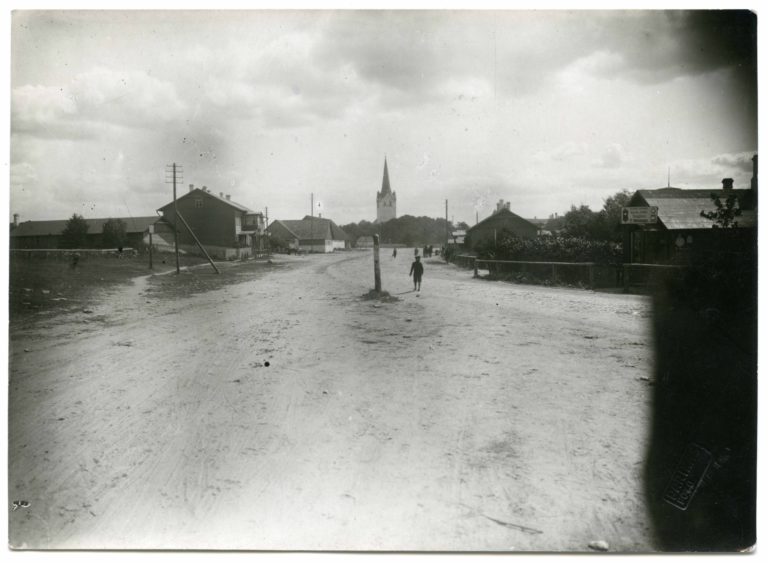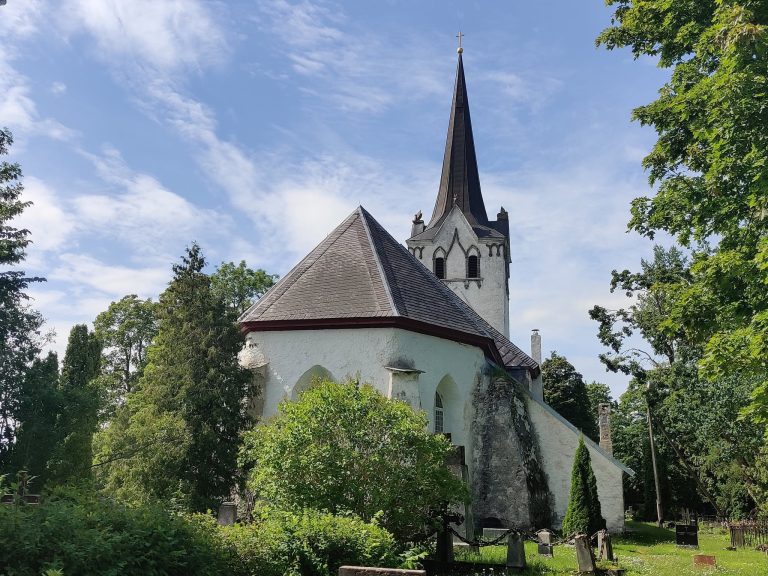
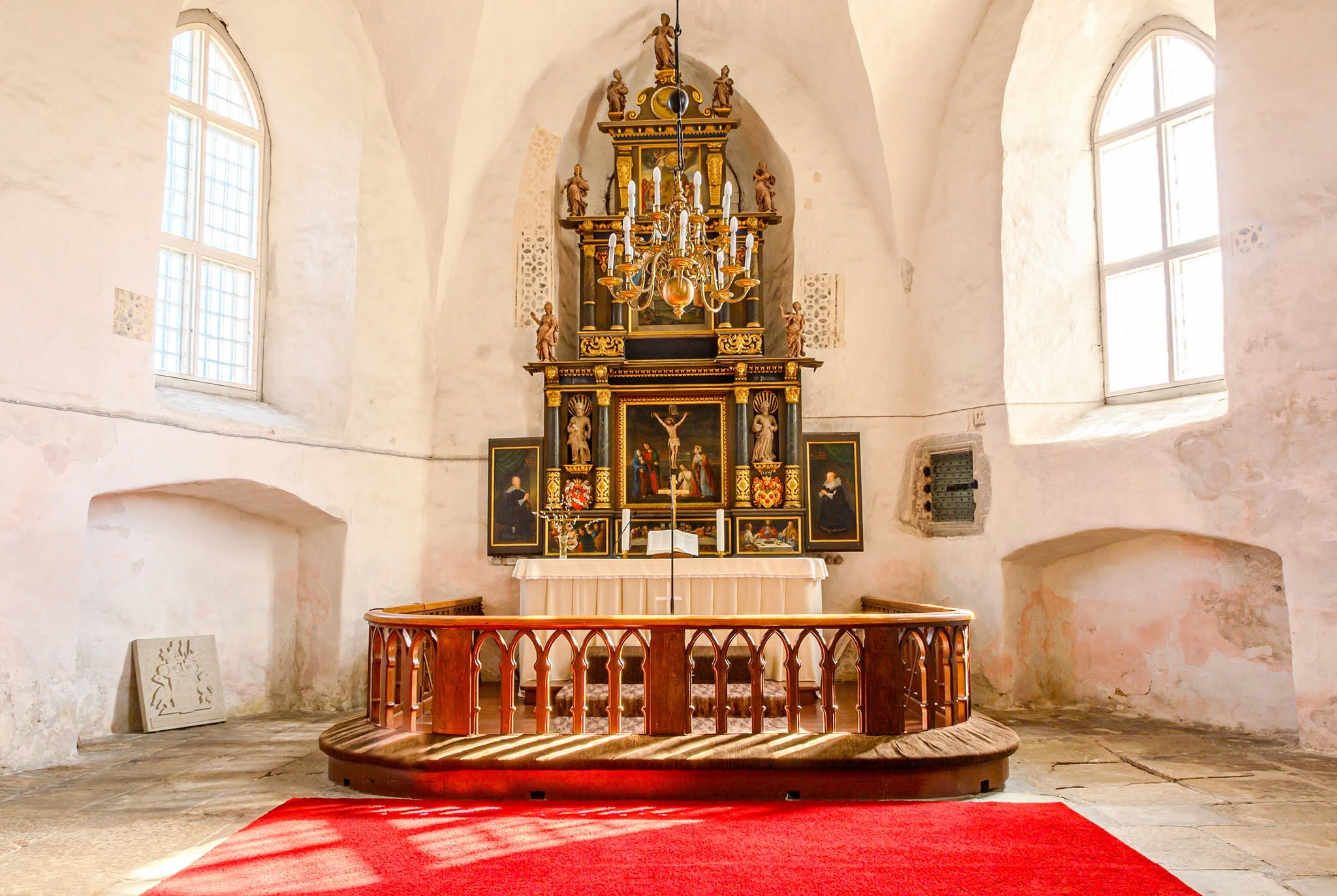
The choir of St. Michael’s Church in Keila is graced by a magnificent Renaissance altar, created in the workshop of Tobias Heintze of Tallinn. The altar was donated to the church in 1632 by Bernhard von Scharenberg and Anna von Rosen, lords of the Sack and Sauss manors.
The explanation below was written by Matthias Burghardt, pastor of the Keila congregation.
The Altar Table and Retable
The altar table is as old as the church in Keila itself, dating from the first half of the 13th century. The altar slab bears a Jerusalem Cross, something unique in Estonia. It is possible that the first clergy members, or the stonemasons who built the altar, used it to identify themselves as pilgrims to Jerusalem.
The altar contains a niche in which relics were kept. These relics conferred a special holiness upon the altar beyond its consecration. The relics—whose associated saints are unknown—were removed during the Reformation in the middle of the 16th century.
The altarpiece (a decorated wooden structure above the altar table) dates from 1632. At that time, Estonia belonged to the Kingdom of Sweden. In July of that same year, King Gustav II Adolf founded the University of Tartu by signing the founding document while on the battlefield of Breitenfeld in Saxony.
The altarpiece was created by Tobias Heintze (c. 1593–1659). It is the only altar retable by Heintze that has survived in Estonia.
The donor figures can be seen on the small side wings: on the left is Privy Councillor and Colonel Bernhard von Scharenberg of Sack and Sauss (1559–1645), and on the right his wife Anna von Rosen (c. 1570–1632). The side wings were removed for a period because members of the congregation did not wish to kneel before the former manor lords when coming to receive Communion. However, the manor lords themselves are shown kneeling before Christ. Furthermore, they are depicted from the side and as part of the altar rather than facing the viewer directly. They therefore remind the congregation that, in Holy Communion, we are united with those “who have gone before us in faith” (Communion liturgy).
The retable is theologically centered on Jesus Christ, His word, and His work. In many respects, it serves as an expression of Lutheran theology during the period known as “Lutheran Orthodoxy” in the 16th and 17th centuries. On the one hand, Christ-centeredness remains a defining characteristic of Lutheran theology. On the other hand, the essential statements of the Lutheran confession are presented here in a particularly concentrated form, something rarely found elsewhere in Estonia.
Below is an overall concept of the images and sculptures. The diagram shows where each element can be found on the altar — numbers (1–7) mark the panels, letters (A, B) the apostle figures, and letters (D–J) the virtue figures.

Vertical Axis: The Death and Resurrection of Christ
The image at the bottom center (1) is a copy of Leonardo da Vinci’s The Last Supper, originally painted between 1495 and 1497. The altarpiece was restored at the end of the 19th century. Since the original Communion scene could no longer be reconstructed, the restorer simply painted this famous copy into the space. The depiction of the Last Supper in this position is not unusual.
Above it is the Crucifixion scene (2), presented as the central image of the altar. Its central position reflects the Lutheran esteem for the Apostle Paul, who writes in Galatians that he wishes to know nothing except the crucified Jesus Christ. The current painting appears to date from the 19th century; perhaps the original Crucifixion scene could no longer be restored.
Its iconography resembles that of paintings from the same period: only Jesus’ friends remain with Him. His enemies, or the crowds often depicted in medieval paintings, are absent. To the right of the crucified Christ stand John and Mary, the mother of Jesus. Jesus has just entrusted them to one another: “Woman, behold your son… Behold your mother.” (John 19:26–27)
Mary appears more bewildered than despairing. Christ—and through Him, John—looks upon her and cares for her.
Kneeling beneath the cross is Mary Magdalene, recognizable by her loose hair, something considered improper for women in the Near East during Jesus’ time. Traditionally, she has been identified with the sinful woman in Luke 7:36–50, where Jesus is anointed. At the conclusion of that story Jesus says: “Her many sins have been forgiven, for she loved much; but he who is forgiven little loves little.” (Luke 7:47)
The third woman, standing on the far left, is Mary, the wife of Clopas, mentioned in John 19:25 as “his mother’s sister.” It was not uncommon to refer to a sister-in-law as a sister, whereas it is unlikely that two biological sisters would bear the same name. She wears garments in the same colors as Clopas, who appears in a later panel depicting the disciples on the road to Emmaus.
The three women foreshadow the continuation of the story: on the first day of the week they come to the tomb with ointments to anoint Jesus’ body. But the tomb is empty, and the Lord has risen.
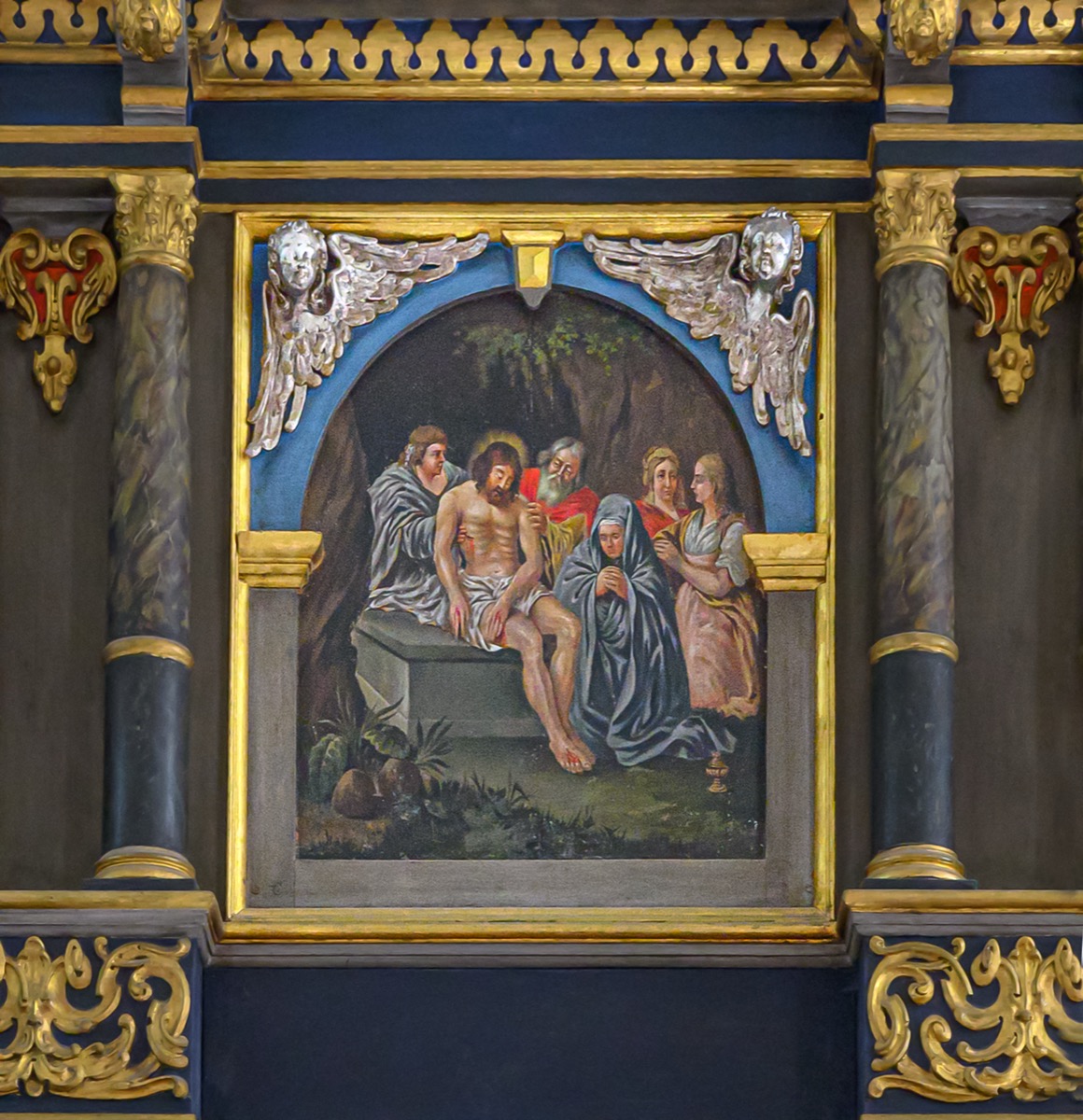
The image above the Crucifixion (3), depicting the Entombment of Christ, is emphasized by the silver angels on the upper frame and by its central position relative to the other images. The angels refer to the Ark of the Covenant, the symbol of the covenant between God and the people of Israel (Exodus 25:18–22). The Ark stood in the Holy of Holies in the Temple of Jerusalem and served as the throne of God, who is described as being “enthroned above the cherubim” (Psalm 80:2). In Luther’s Bible translation, the cover of the Ark is called the “Mercy throne.”
Inside the Ark were the tablets of the Ten Commandments, Aaron’s staff that had budded, and manna—the food God provided during Israel’s journey through the wilderness—all symbols of the covenant. Remarkably, the Ark also appears in the painting itself. Here it serves as Christ’s bier or deathbed, upon which the crucified Lord sits enthroned. Through Christ, God establishes the New Covenant in His blood—that is, through His death and resurrection.
The divine name “Yahweh” (“I Am”) is repeatedly associated with Christ in the Gospel of John, for example in the words: “I am the good shepherd.” (John 10:11) The place of Christ’s death and resurrection is represented by this deathbed, symbolically depicted as the Ark of the New Covenant.
The halo around Christ’s head already points toward the coming Resurrection, as do the ointment vessels at the bottom of the painting. Similar vessels also appear at the foot of the triumphal cross located between the pulpit and the gallery, which separates the nave from the chancel. Thus Christ’s death and resurrection are brought together within a single image.
Two stones in the lower left corner are also noteworthy. They recall Christ’s temptation in Matthew 4, where the devil challenges Him to turn stones into bread to satisfy His hunger. Jesus replies that man does not live by bread alone. In this painting, the stones remain stones. Christ remained faithful to God even unto death and Himself became the manna, the heavenly bread of life for those who hunger for life, love, and forgiveness.
The mourners surrounding Christ are familiar figures: Mary, the mother of Jesus, depicted in deep grief; Mary Magdalene; Mary, the wife of Clopas; and on the left, John, the only male disciple who remained with Christ until His death.
John places his hand upon Christ’s side wound, emphasizing his role as an eyewitness. This refers to John 19:34–35: “One of the soldiers pierced his side with a spear, and immediately blood and water came out. He who saw it has borne witness.”
John supports Christ’s body on one side. On the other side stands Joseph of Arimathea, the wealthy council member in whose tomb Christ was laid. He is identifiable by his rich and colorful clothing. It is evident that this painting, along with the remaining panels (4–7), was created by a different artist—one who was highly skilled not only in biblical interpretation but also in the visual theology of the Reformation. These images were probably only refreshed during the nineteenth century and were otherwise well preserved.
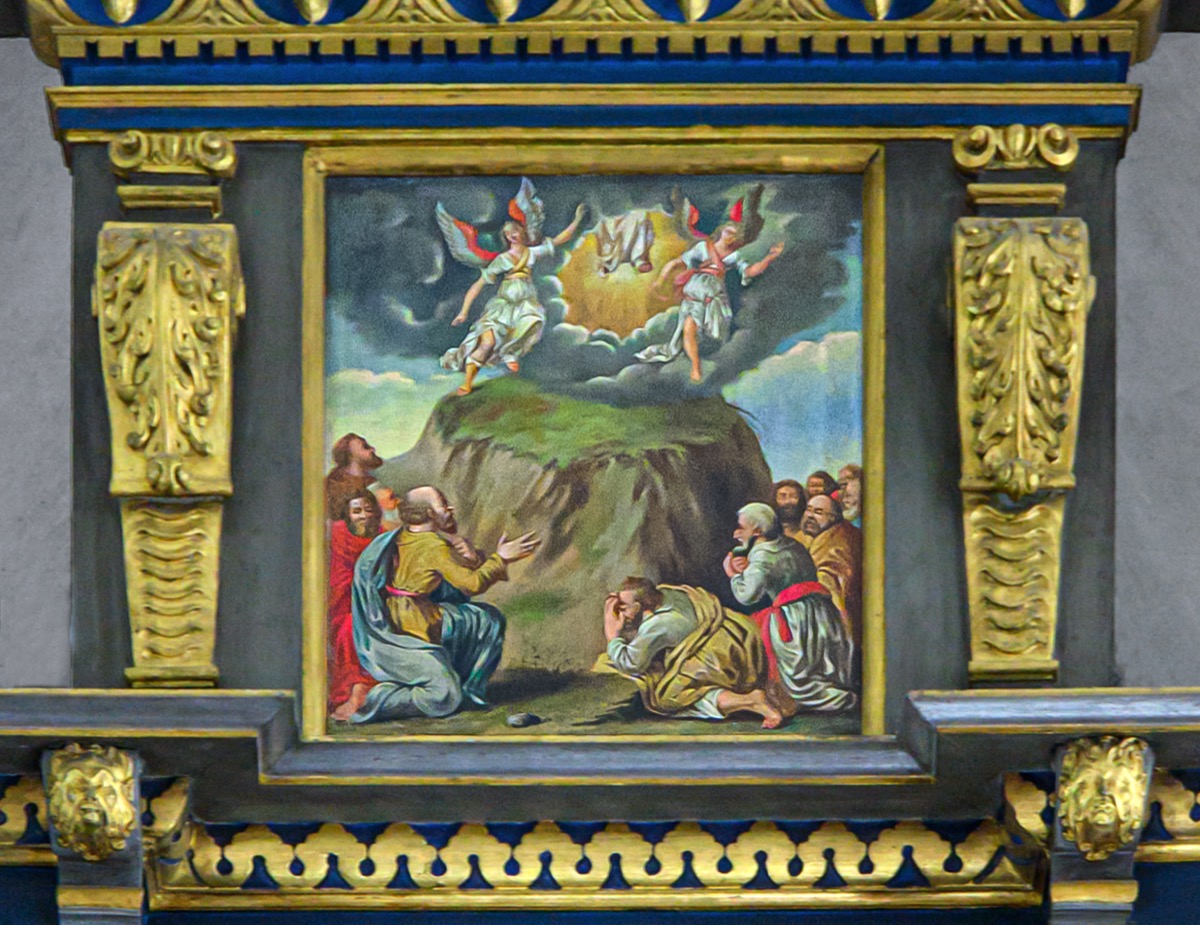
Panel 4 depicts Christ’s Ascension. Because the painting is positioned high above the congregation, less attention was devoted to small details. Although simpler in execution, the image still includes the two angels, who communicate the message of Ascension Day: Jesus Christ is King and has taken His seat at the right hand of God (Hebrews 1:3).
The angels associated with the Ark of the Covenant (see Panel 3) now function as messengers who interpret the Ascension for the disciples. According to the Acts of the Apostles, they tell the disciples that Christ will return in the same way they have seen Him ascend into heaven (Acts 1:10–11). Afterward, the disciples return to Jerusalem.
Panel 5 concludes the story of Christ’s suffering and resurrection. It depicts the dove, the symbol of the Holy Spirit, who was poured out upon Christ’s waiting community on the Day of Pentecost. With this event, the Christian Church begins: Filled with joy and freed from fear, Christians proclaim the Good News of Jesus Christ to others—a mission that continues to this day.
The dove as a symbol of the Holy Spirit is first introduced at Jesus’ baptism in the Jordan River (Matthew 3:16). Just as God’s Spirit is united with Christ, so too He unites Himself with those who believe in Christ. This promise is also visible at the church’s tower entrance, where the dove is displayed above the portal.
The dove also recalls the end of the Flood in the story of Noah’s Ark (Genesis 8:11). In Matthew’s Gospel, this imagery is connected with Christ’s work on the cross: Jesus takes upon Himself human guilt and its punishment and grants peace to those who believe in Him. The dove thus becomes a symbol of peace, reconciliation with God, reconciliation among people, and the new creation.
The Horizontal Axis: Food and Fellowship
In addition to the vertical sequence of images (1–5), there is a smaller horizontal axis consisting of Panels 6, 1 and 7. These images are also composed with great theological sophistication. Both focus on food and eating, which is fitting for a Christian altar. Unlike ancient sacrificial altars, the Christian altar serves primarily for prayer and the celebration of Holy Communion.
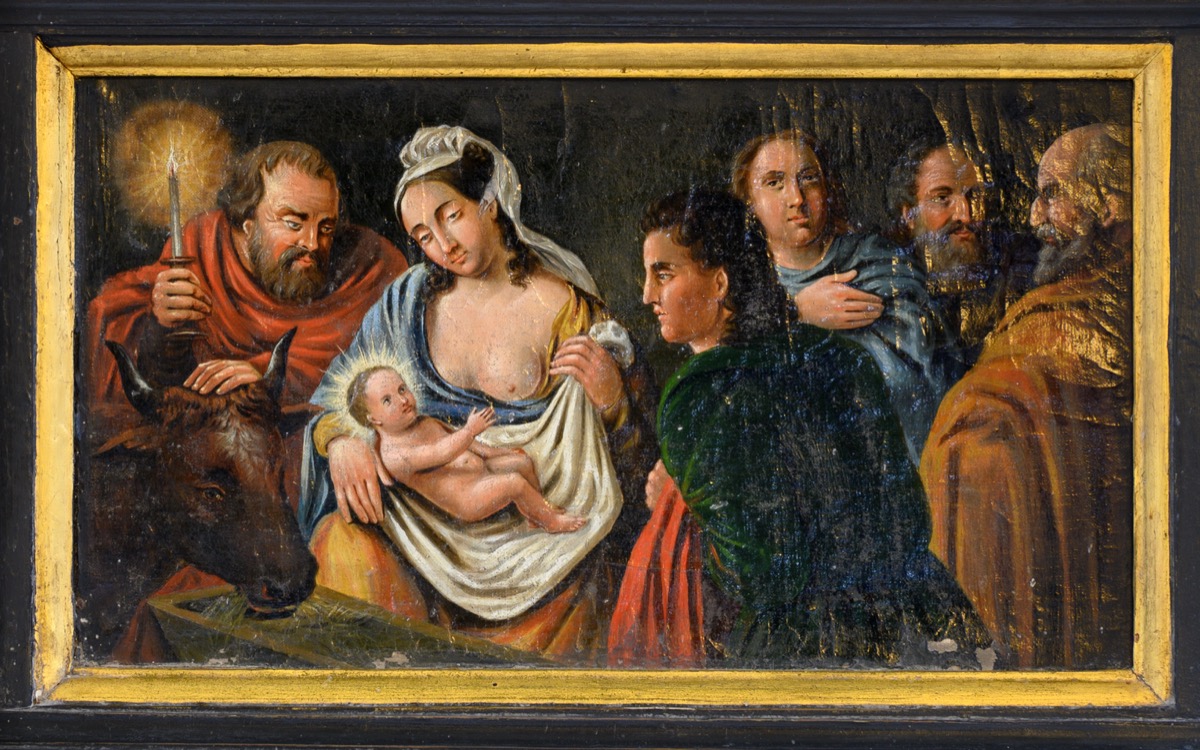
Panel 6 is Keila’s Christmas image. It depicts the Adoration of the Shepherds in the stable at Bethlehem, where Jesus was born. A striking detail is that the hand of the Christ Child, who occupies the center of the composition, is directed toward the prominently displayed breast of Mary. This is certainly not due to the artist’s ignorance of child development (infants that young cannot intentionally grasp objects). Rather, it expresses the central message of the image: “Give me food!”
According to Christian teaching, through baptism a person is born anew and receives eternal life. The new person is symbolized here by the Christ Child, who wishes to grow within us and therefore requires nourishment: The Word and the Sacraments, prayer, and the fellowship of believers. The First Letter of Peter encourages the congregation: “Like newborn infants, long for the pure spiritual milk, that by it you may grow into salvation.” (1 Peter 2:2)
To the left of the Christ Child, Joseph holds a light, symbolizing Christ as the Light of the World: “The light shines in the darkness, and the darkness has not overcome it.” (John 1:5) The light also recalls a baptismal or Easter candle. Even the ox peacefully eating hay from the manger carries a biblical message: “The ox knows its owner, and the donkey its master’s manger, but Israel does not know, my people do not understand.” (Isaiah 1:3)
Thus the Holy Family is framed by prophetic references from the Old Testament. The young shepherd in the center of the image—the only figure actually looking directly at the Christ Child—has a dark complexion and long black hair. He is shown in profile, a privilege traditionally reserved for rulers. His features conform to the classical ideal of beauty inherited from antiquity. This handsome Mediterranean-looking shepherd may represent King David, the ancestor of Christ, who was himself anointed as king while still a shepherd boy from Bethlehem. The biblical description of David reads: “He was ruddy, with beautiful eyes and a handsome appearance.” (1 Samuel 16:12)
David’s presence is not explained merely by his ancestry or his shepherd’s occupation. Like the ox on the left side of the image, he points to a prophecy of Isaiah traditionally read at Christmas: “Of the greatness of his government and peace there will be no end. He will reign on David’s throne and over his kingdom, establishing and upholding.” (Isaiah 9:7)
The group of three men on the right side belongs compositionally to the worshiping shepherds. However, only the man at the far right directs his gaze toward Christ. The man to his left looks at him. The third man, in the middle, looks directly at the viewer.
For this glance there are two explanations possible: The first is that the blond, beardless man has already died and therefore looks beyond the painted world into our own (3rd) dimension. However, this interpretation seems unlikely, since the congregation of the 17th century would have needed to know him for such symbolism to be meaningful.
The more probable explanation is that this figure is Tobias Heintze, the artist himself. This interpretation is reinforced by his right hand—the hand with which he created the artwork. In a respectful gesture, it points toward the man on the far right. That man closely resembles Bernhard von Scharenberg, the sponsor of the altarpiece, who is also depicted on the altar wing. Like a ruler, he too is shown in profile. The identity of the third man remains unknown, though he must have been recognizable to the seventeenth-century congregation. Possibilities include: Heinrich Bartholin of Turku (c. 1600–1658), pastor of Keila from 1627 to 1639; or Stephan Badwitz of Pomerania, whose initiative led to the restoration of the church after the Livonian War.
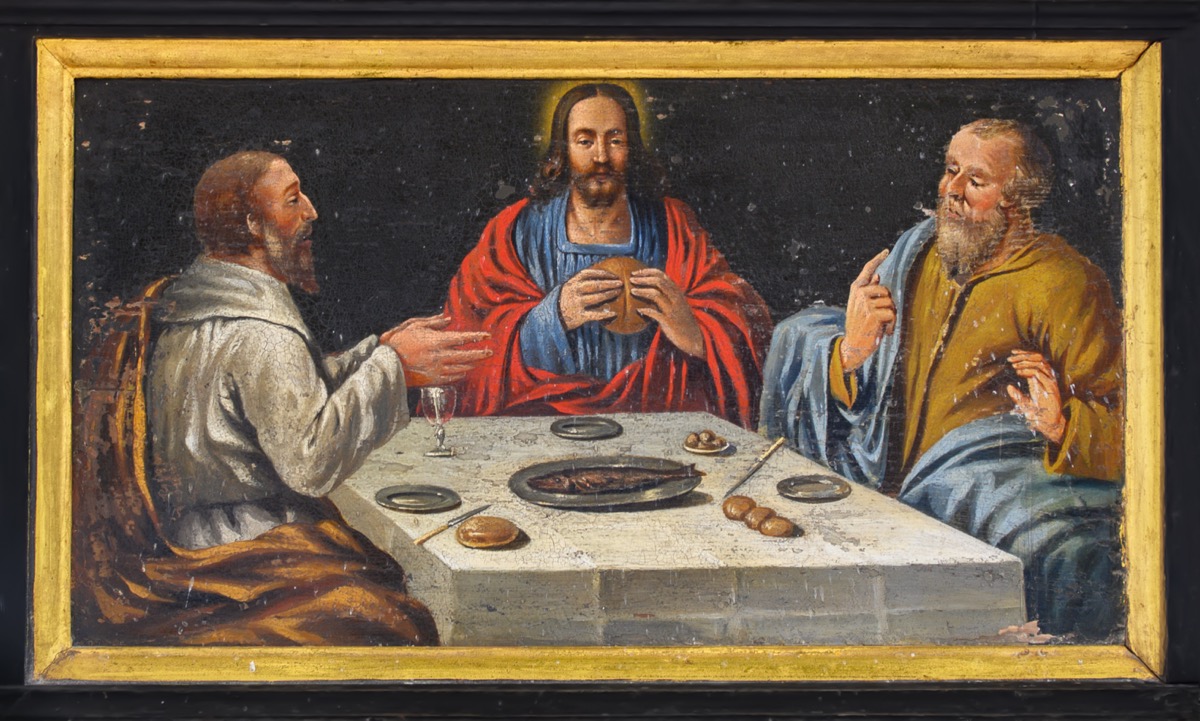
Panel 7 is the Easter image of the retable. It depicts the decisive moment in the story of the disciples on the road to Emmaus (Luke 24). The disciples recognize Christ precisely as He breaks the bread. The artist has captured this instant of recognition masterfully.
Christ’s hands are fully occupied with the act of breaking the bread. The disciple on the left has opened his eyes only slightly. He is just beginning to recognize Christ, and this realization occurs at exactly the same moment that the Lord breaks the bread. Yet his body language has not fully expressed the realization. In the next instant, he will throw his eyes wide open, his mouth will open in astonishment, and his hands will rise in amazement.
Clopas, seated to Christ’s right (from the viewer’s perspective), has his eyes closed. His gesture suggests that he recognizes the Lord by His voice: “But that’s…!” Like the other disciple, he is on the verge of visibly expressing his astonishment.
The moment of recognition reminds the congregation that the Lord celebrates Holy Communion with them. Christ is present in the celebration itself. According to Lutheran teaching, the sacrament consists in the act itself—in Word, faith, and action. Christ is present: “in, with, and under” the bread and wine of the Eucharist. The congregation is therefore called to recognize Him there.
Just as the Christmas image (Panel 6) also concerns rebirth through Holy Baptism, the Easter image focuses on the other Lutheran sacrament: Holy Communion.
Several symbolic objects appear on the table: The fish is an ancient symbol of Christ. Christ gives Himself in Holy Communion for our salvation. It also refers to Jesus’ call to Peter: “Follow me, and I will make you fishers of men.” (Matthew 4:19)
The small loaves recall the Feeding of the Five Thousand (Mark 6:41), where Jesus multiplied five loaves and two fish. The message is that Christ can make much from the little that we possess. Their shape resembles a braided Easter bread, a traditional Easter pastry documented since at least the twelfth century.
The wine glasses are transparent. This symbolizes that the Gospel has come to light in its pure form and that the communion cup may be shared by laypeople as well as clergy.
The two knives recall the medieval doctrine of the Two Swords, which later influenced Martin Luther’s doctrine of the Two Kingdoms. Church and state are not to be confused with one another. Each has its own responsibilities, yet both are related through the Gospel.
The Sculptures: Apostles and Masks
The carved decorations of the altar are rich and intricate. The largest figures are the apostles Peter and Paul (A and B). Their joint depiction often symbolizes peace within the Church and acceptance of differing viewpoints.
According to Acts 15 and Galatians 2, Peter and Paul disagreed over whether Gentiles could become Christians without first being circumcised. In the end, they extended the hand of fellowship to one another—not because they agreed on everything, but because each recognized the work of the same Spirit of Christ in the other. The Council of Jerusalem thus resolved a dispute that might otherwise have split the young Church apart. Their presence together on the altar therefore symbolizes different ways of living out the Christian faith in different circumstances while remaining united in Christ.
The small masks (C) that serve as capitals atop the decorative columns may represent either the seasons of the year, or the cardinal directions.
The Virtues: A–J
The female figures surrounding the retable are particularly remarkable and rarely encountered in this form. They represent the traditional virtues — three Christian virtues, and four classical philosophical (Aristotelian) virtues. At the top sit the three Christian virtues, below them the four classical (Aristotelian) virtues.
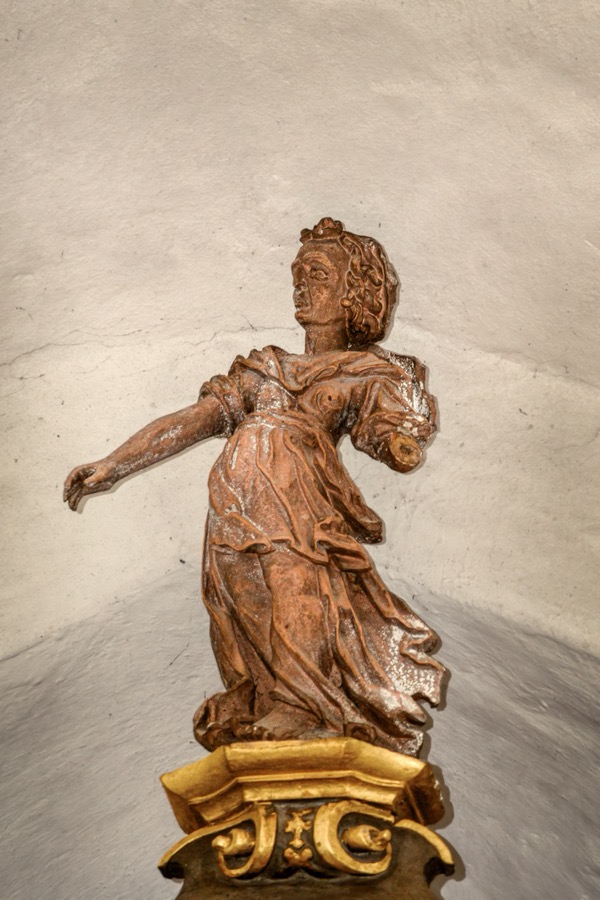 Faith (Fides) – D. Faith occupies the highest position. Martin Luther taught that human beings are saved and receive God’s grace through faith in Christ alone. Faith is therefore both the goal and the prerequisite of the Christian life. It is what the story of Jesus awakens in us, yet it is also what enables us to understand that story correctly. Its attribute—the cross—was perhaps already stolen during the Great Northern War.
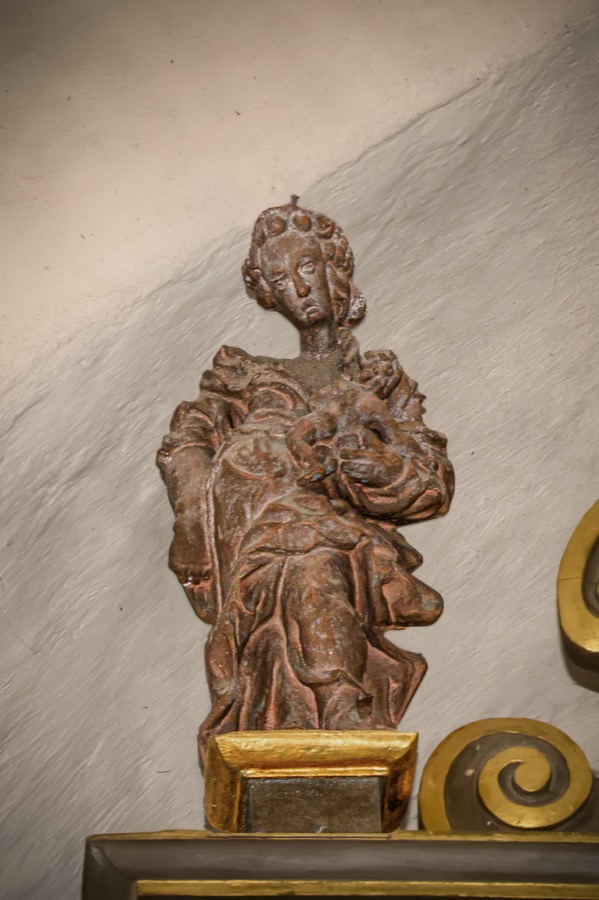 Love (Caritas) – E. To Faith’s right (the viewer’s left) stands Love, holding a child in her arms. Paul writes: “And now these three remain: faith, hope, and love. But the greatest of these is love.” (1 Corinthians 13:13) Love is therefore the virtue Christians should pursue above all.
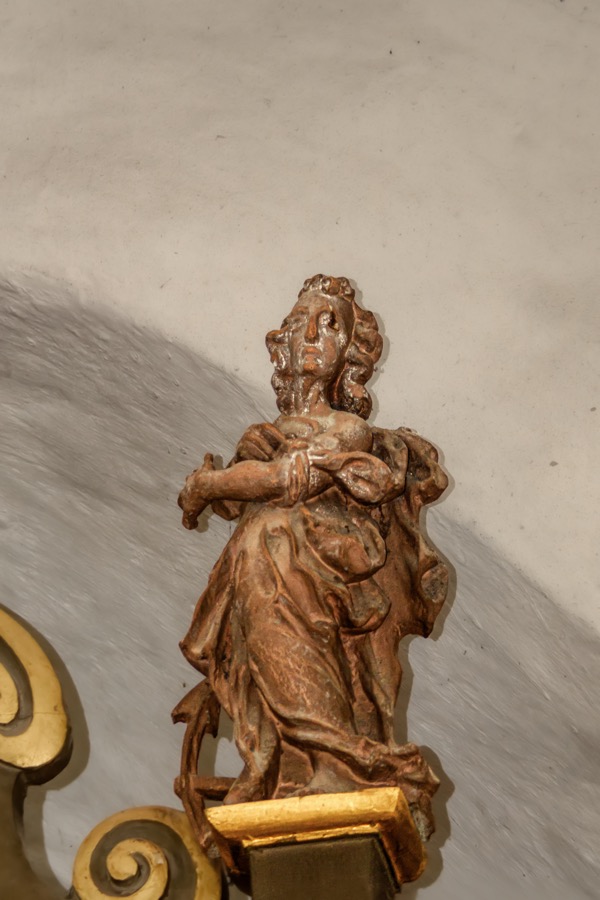 Hope (Spes) – F. On the opposite side stands Hope, recognizable by the anchor at her feet.
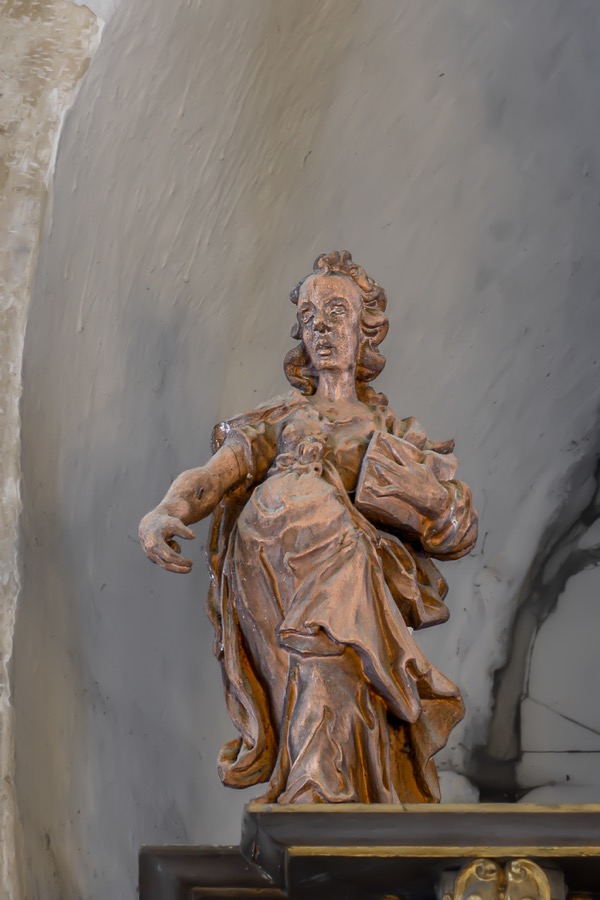 Prudence / Wisdom (Prudentia) – G. Prominently placed on the left side, she holds a book in her hand. Education has always been an important concern of the Lutheran Church, especially through Bible translations, catechisms, and the establishment of schools. Christians are encouraged to seek knowledge, use their reason, and love God with their minds as well as their hearts: “You shall love the Lord your God with all your heart, with all your soul, and with all your mind.” (Matthew 22:37) For this reason, Wisdom stands on the same side as Love.
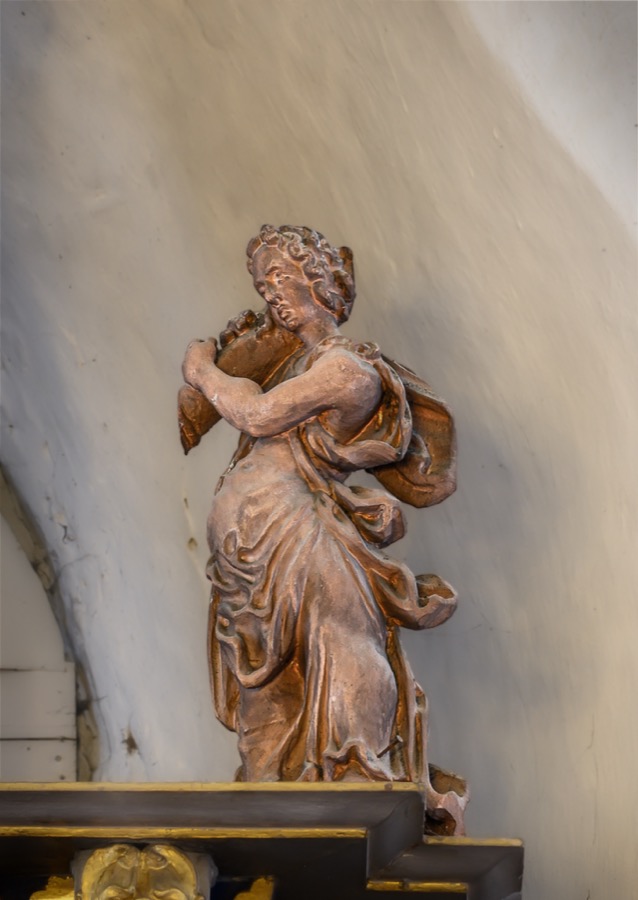 Fortitude / Courage (Fortitudo) – H. On the opposite side stands Fortitude. She fearlessly overcomes obstacles and refuses to be intimidated, carrying away a tree trunk and clearing the path ahead.
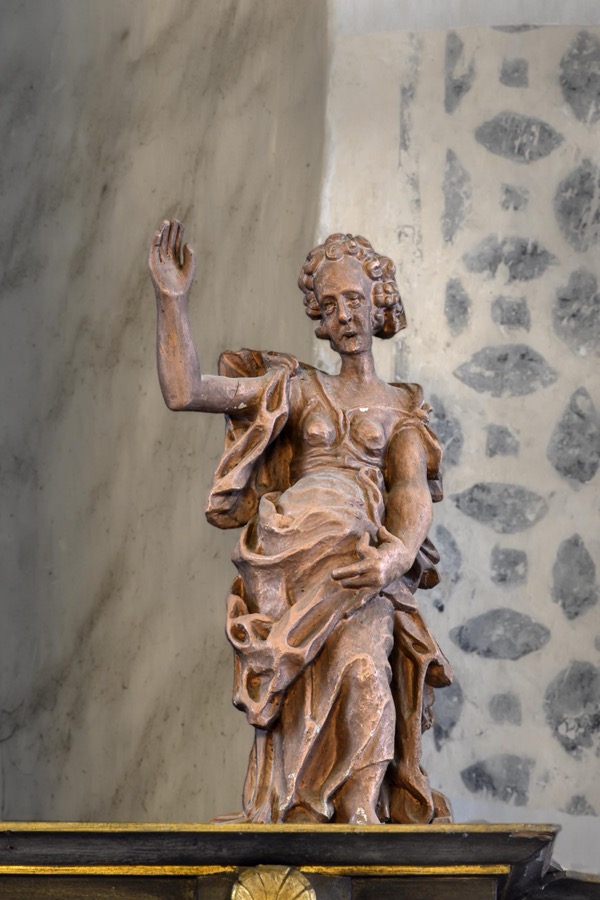 Temperance (Temperantia) – I. Below Fortitude appears Temperance. This virtue encourages self-control and moderation. The Apostle Paul writes: “Everything is permissible for me, but I will not be enslaved by anything.” (1 Corinthians 6:12)
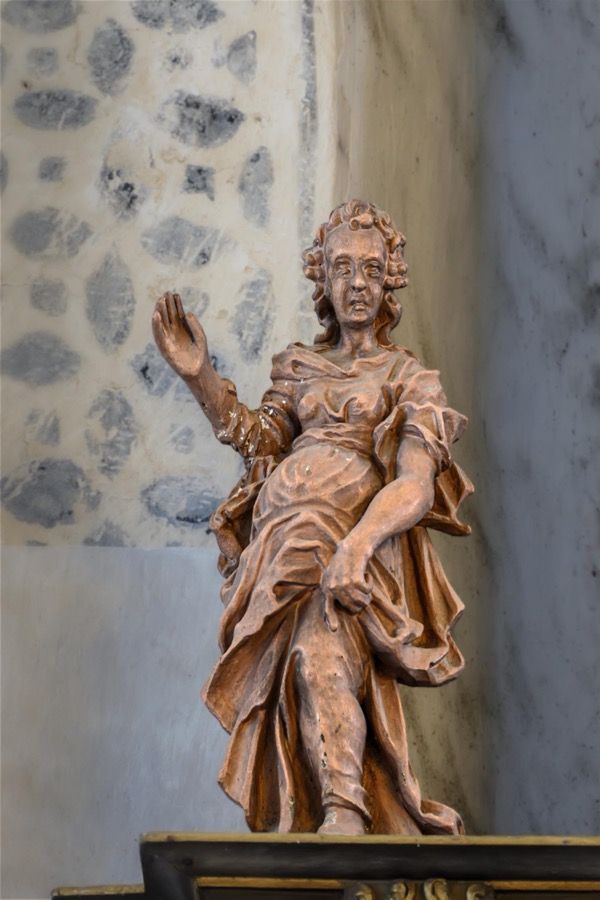 Perseverance Instead of Justice – J. The final virtue initially presents a puzzle. According to the traditional list of virtues, this figure should represent Justice. Yet she lacks Justice’s customary attributes, such as scales and a blindfold. Nor does she display any obvious balancing or judging function. Instead, she draws attention to her unusually large and powerful leg.Lutheran doctrine does not primarily view righteousness as a human virtue but as a gift from God. Through Christ, believers are justified: they receive Christ’s righteousness, while Christ takes upon Himself their sinfulness, which He bore on the cross (Colossians 2:14). As a result, righteousness remains a virtue only in human relationships; in an existential and theological sense, it is a gift. According to the Augsburg Confession, one of the most important confessional documents of the Lutheran Church, the doctrine of justification is “the article by which the Church stands or falls.”Martin Luther therefore suggested on several occasions—among them in his commentary on Ecclesiastes—that Perseverance (Perseverantia) should replace Justice in the traditional list of virtues. The believer is called to remain steadfast in faith. Thus the virtue points toward her strong supporting leg, as if echoing Luther’s famous words before the Imperial Diet of Worms in 1521: “Here I stand. I can do no other. God help me. Amen.”
This collection of virtues is therefore one of the very few Lutheran virtue programs of its kind and is likely the only example in Estonia.
It is truly impressive how much depth, theological knowledge, and artistic beauty Tobias Heintze invested in creating this retable. We hope that viewing it brings you as much joy as it brings us.
Matthias Burghardt, Pastor of the Keila Congregation